Wednesday, February 15, 2006

Lesson-41 : WCM Vs Carnatic - Philosophical Comparisons

Hi All,

Warning : Once I start this topic on WCM Vs Carnatic, I may wander here and there and it is the responsibility of the reader to collect and correlate whatever useful contents from these discussions, as he feels so !

Disclaimer : Any view expressed here is of author only and at the same time author is not to entertain any “How dare you can Compare this and that “ sort of complaints ! .

Read the following Q & A
(This may not be word by word translation, but just conveying the overall meaning of Q & A.) :

“Why there are no significant Carnatic based songs from you ? “

“If I don’t spoil Carnatic music, that’s the service I am making to that (laughs)…”

The period was somewhere around 1978 and that was in one of the Radio interview and you might have guessed by now, that the answer was from IR !

Really shocking and surprised you are…Aren’t you ?

I also felt that shock because, around that time, I started hearing from various news/ tidbits that IR was learning Carnatic music daily in the morning with some famous carnatic musical Gurus….!

Imagine a gold medallist of Trinity College in WCM, starts his lessons on Carnatic at that age and also when he was already a roaring success in film world!

Don't forget the decade of film composing experience of IR before Annakkili as an associate with GKV etc!

One cannot doubt his Carnatic music knowledge, if you carefully analyse even his initial two years of hit songs! A wider spectrum of Carnatic base and innovations can be easily identified even now!

In spite of all these, IR still felt that he shall formally learn Carnatic music. Because he felt knowledge is not sufficient, attaining skills are what the primary requirement!

My point here is, I view IR as WCM expert who tread into the Carnatic field and obtained the expertise of that also and then expanded his horizons !

Having the advantage of not started the Carnatic first, his perceptions of Carnatic music are flexible & unbiased and he might have approached Carnatic from the point of view of WCM, which he already knows thoroughly.

So while learning and expertising the Carnatic music, he interchangeably superimposed the one philosophy and rules over the other !

( I repeat the words Philosophy and Rules ! The one who knew both, applied exactly the rules and philosophy ! Its others perception that he violates the other ! )
That made and even now makes IR different !

As the beginners to both WCM and Carnatic, let us also get into the path IR might have followed and look at the both the perspectives…!

Because…… IR’s WCM is Carnaticised and IR’s Carnatic is also WCMised…!

Three major Philosophies and Perspectives we shall have to study to understand his amazing creations !

First : Scale Vs Raagam Concepts !
Second : Modulation Concepts !

Third : Harmony Concepts!

Then let us have begining with a small learning of above perceptions of both the fields…!

Tuesday, February 14, 2006

Lesson-42 : WCM Vs Carnatic - Scale Vs Raagam - Pattern Formation Comparison

Let us take the Pattern Formation of both WCM and Carnatic.

We have seen the pattern construction of WCM scales.

Basically, the exercises involved the following two things:

1) Selecting a Note as Tonic

2) Based on this Tonic, construct the Pre-determined Pattern (either Major or Minor as required for us)


For further variations, we shifted the Tonic (say by Perfect 5th upwards or downwards) and repeated the pattern formation. We are sure and know that we struggled to keep the pattern same..!
To say it in simple logical way, We kept changing the Tonic as per Step-1, whereas the Pattern in Step-2 exercise remained and kept absolutely the same.

Imagine, the reverse of this…..!

Meaning, keep the Step-1 constant, and Change the very pattern itself ! That’s’ Carnatic scheme of pattern formation.

Because,,,,,,,Carnatic Philosophy is

“Select any one note as the Tonic…

Then onwards, that Tonic SHOULD BE / MUST BE / COMPULSORILY maintained and remain same……! Through out the concert……!”

You might have noticed the Thampoora….or… Shruthi Petti …. etc.. being the integral part of any Carnatic concert….!

Now do you realize the importance of such instrument……?

This makes you to stick to the note you started as Tonic and help in remaining in that Tonic through out the concert…!

Percussion instrument like Mridhangam etc are having equal importance in Carnatic concert…! These are also tuned based on the tonic shruthi set in Tampura , shruthi petti…etc !

While the vocal and instruments like violin can pick-up and adjust quickly to the shruthi required, It is difficult to adjust and change the shruthi of these percussion instruments which will take considerable time…!

Imagine in the middle of the concert or between songs, if the Tonic changes…! then the whole Carnatic orchestral system arrangement will go haywire….!

Abaswarams…the great sin…!
When you compare this with WCM system, because of the frequent shifting of tonics, you generally never find the percussion instrument separately (except in few operas –dramas - for any dramatic effect and occasional/ selected usage in symphonies…! ).

So back to track…! In nut shell, if we compare the basic philosophies,

WCM scheme Fixed the Pattern and Changed the Tonic

Carnatic scheme Fixed the Tonic and Changed the Pattern itself….!

Now, you can realize the opportunity Carnatic is giving us …..in terms of pattern formation….!

While WCM prescribed only Two main patterns ( Major & Minor ), Carnatic scheme can have millions of Pattern formations…!
It is better to have the basic knowledge of Pattern formations of Carnatic scheme.

Again everything is mathematics…! Some Permutaions & Combinations !

We will see that in our next session…!

Monday, February 13, 2006

Lesson-43 : Carnatic Ragam Pattern Formation - Part-1 - Basics

Let us continue our discussions on Pattern Formation as visualized by Carnatic scheme…!

As many of you already aware, Carnatic Scheme has 7 notes, Sa, Ri, Ga, Ma, Pa, Dha, Ni

Now, in WCM system we know that there are 12 keys (black and white) for an octave.

But in reality Carnatic scheme has 16 notes in total between Tonic to Ocatve !

While Sa and Pa has no variations, Ma has 2 variations and the balance Ri, Ga, Dha and Ni have 3 variations each, totalling to 16 notes between an Octave.

These are tabulated below:


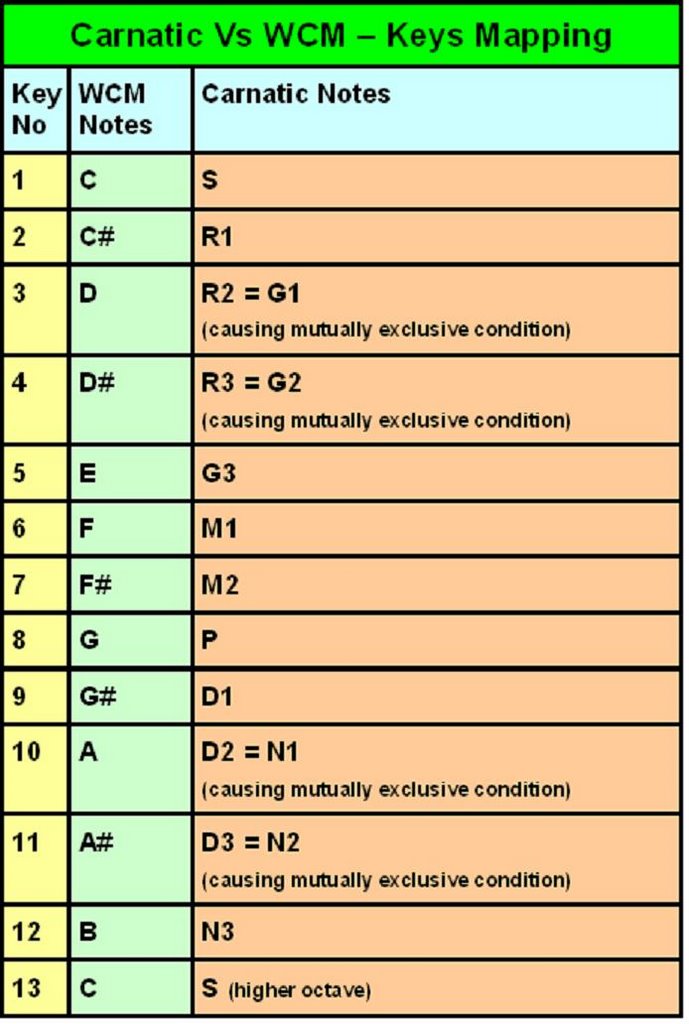
However, the variation between certain notes like (R2 & G1) , (R3 & G2) , (D2 & N1) and (D3 & N2) are so minute, you can ignore that variation and represent these 16 keys in the 12 key system as below:


For our discussion purposes, let us presume that middle “C” as our Fixed Tonic as required by Carnatic. We have to use these 12 notes to form a pattern of Carnatic Scheme. How many notes to select…?

Carnatic scheme at the outset demands 7 notes (or less…! )

(Remember WCM demands strictly 7 notes and nothing less or more is accepted..! ).
Let us analyse the case of 7 notes selection ( viz. Sa Ri Ga Ma Pa Dha Ni) out of 12 notes available.
Also, there are certain restrictions of notes posed while selection :

Certain notes are must (Sa & Pa) and the notes which have alternatives (Ri, Ga, Ma, Dha & Ni ) you shall select within that alternatives satisfying certain mutually exclusives conditions.

Conditions :

Sa and Pa have no variations and must be selected.

Ma is having 2 variant and select any one at a time.

Ri, Ga, Dha and Ni are having 3 variants each out of which you select any one variant for each.

(At the same time in certain variants, mutually exclusive conditions arise between Ri & Ga as well as Dha & Ni due to the adoption of the method of 16 notes represented in the 12 Keys.)

To explain the above visually, let me give the Comparative position of the 12 keys - Carnatic Vs WCM as below : (Taking C as the Tonic, Sa ) To simplify let us also use only the Sharps


For example…..

- If R1 is selected, we have 3 options for Ga …….as G1 or G2 or G3.
- If we select R2, our options for Ga is restricted to ……..either G2 or G3 only (as G1 is ruled out by R2 selection)
- If R3 is selected, our option for Ga is restricted to…… G3 only, (as G1 is crossed and G2 is ruled out by R3 selection)

Similarly

- If D1 is selected, we have 3 options for Ni …….as N1 or N2 or N3.
- If we select D2, our options for Ni is restricted to ……..either N2 or N3 only (as N1 is ruled out by D2 selection).
- If D3 is selected, our option for Ni is restricted to…… N3 only, (as N1 is crossed and N2 is ruled out by D3 selection)

With the above set of conditions we can start with our Carnatic Raga Pattern Formation which is purely as per mathematical topic of "Permutation & Combinations".

We can see that in our next session.

Sunday, February 12, 2006

Lesson-44 : Carnatic Ragam Pattern Formation - Part-2 - Melakartha Formation

So the Carnatic Pattern formation basically involves selecting the 7 notes from the 12 keys, satisfying certain mutually exclusive conditions described earlier.

Let us recall those conditions:

Sa must be Selected.

Pa must be Selected.

Ma have two variations M1 or M2

- If R1 is selected, we have 3 options for Ga …….as G1 or G2 or G3.

- If we select R2, our choice for Ga is restricted to 2 options……..either G2 or G3 only
(as G1 is ruled out by R2 selection)

- If R3 is selected, our choice for Ga is restricted to 1 option …… G3 only,
(as G1 is crossed and G2 is ruled out by R3 selection)

Similarly

- If D1 is selected, we have 3 options for Ni …….as N1 or N2 or N3.

- If we select D2, our 2 options for Ni is restricted to ……..either N2 or N3 only
(as N1 is ruled out by D2 selection).

- If D3 is selected, our 1 option for Ni is restricted to…… N3 only,
(as N1 is crossed and N2 is ruled out by D3 selection)

Mathematically, the selection process will give a table of 72 basic patterns called “Melakartha Raagam”

To illustrate the typical process, let us analyse the first case and extreme cases of Perumnuation Combination

Formation of the first Pattern will be like this :


To complete octave , C is added back

So the resulting pattern is:

C – C# - D – F – G – G# - A – C

(S R1 G1 M1 P D1 N1 S)

The above pattern is called “Kanakangi” in Melakartha Scheme.

Take the extreme 72nd raagam pattern :


The resulting pattern is :

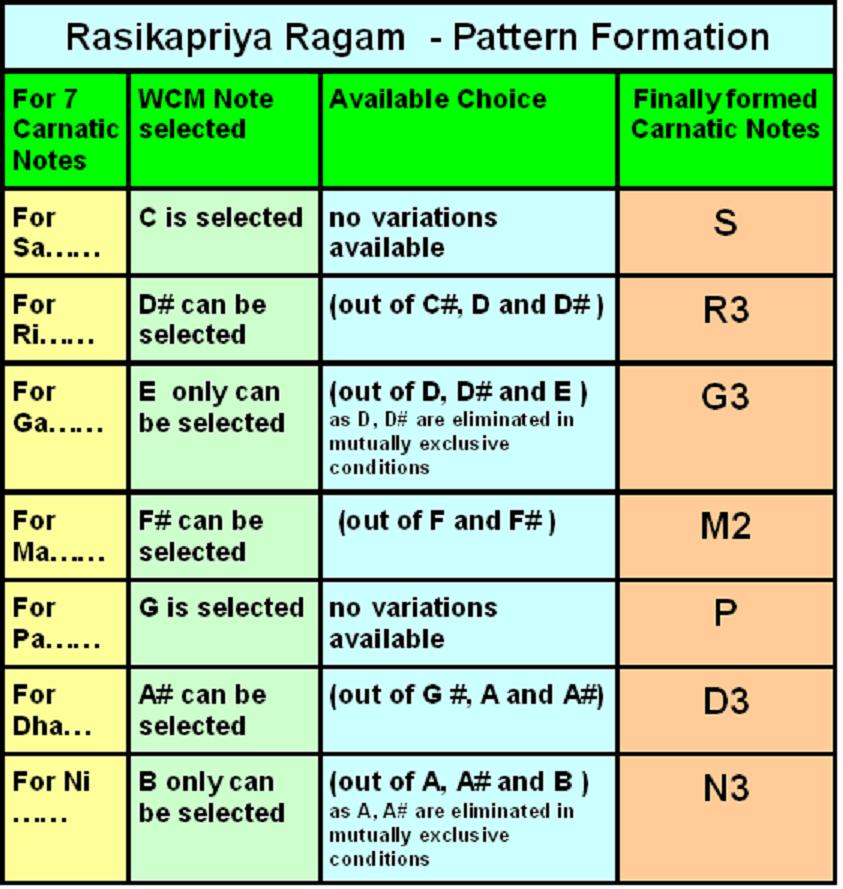
C – D# – E – F# – G – A# – B – C

( S R3 G3 M2 D3 N3 S )

This is called as “Rasikapriya” in Melakartha scheme.

In between the 1st and 72nd ragam , remaining 70 other patterns of Melakartha scheme are arranged.

I am not burdening you with the exercise of formation of balance Pattern formations ! Once you understand the basic principle, you can do that automatically.

Let us have a glimpse of the 72 raagam as in the Melakartha Table, in our next session.

Saturday, February 11, 2006

Lesson-45 : A Glimpse of Melakartha Table

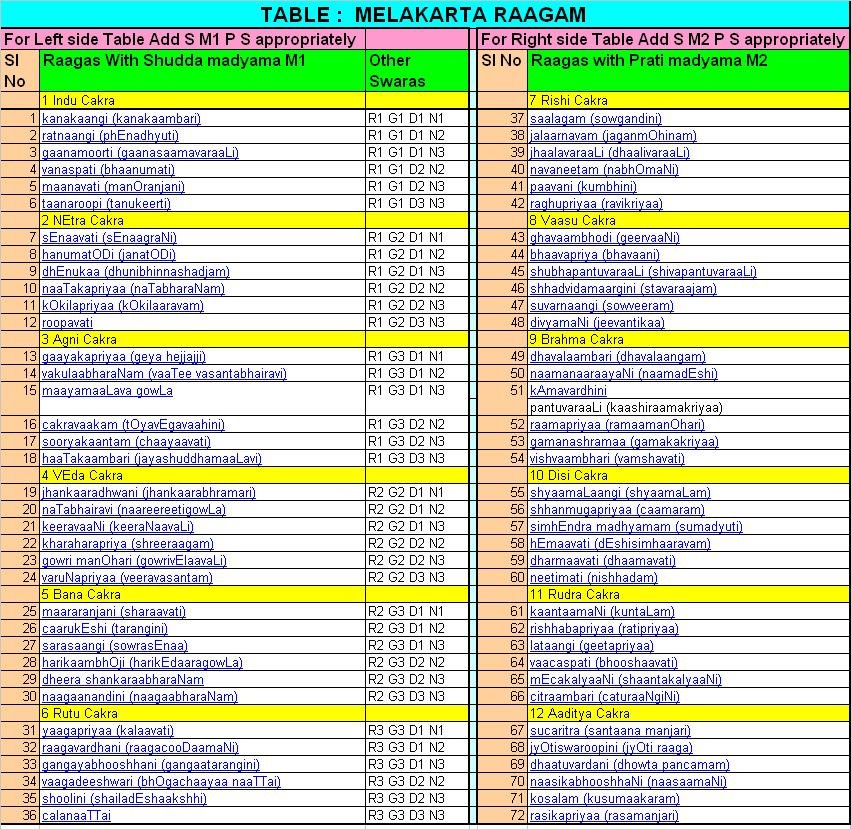
As discussed earlier the basic raagam pattern exercises will yield 72 raagams called Melakartha Ragams.

The Melakartha table is illustrated below for your easy ready reference.

(Click here and Download the Excel File format from the file section of Ilaiyaragam Group)

Examine that carefully…! And particularly visualize their grouping !


They are basically divided into 2 Major divisions

36 ragams based on M1 and remaining 36 ragams based on M2.

Within that also, they are arranged in groups of Six, each called “Chakra”.

Also the name of ragam is so selected that, from the first two letters you can tell their number (there is a method for that !), and from their number you can easily make out that what kind of variants of R, G, D and N are used in that particular raagam.

Amazing…isn’t it…!

Just like Periodic Table we used in the Chemistry …..! Very number will indicate you the property of the element…!

Also, you can see from the Melakartha table and examine the Sanakarabaranam pattern (no 29 ) and check whether it matches with our Major Scale pattern.

Similarly, Keeravani (21) matches our Harmonic minor scale, Gowri Manohari (23) matches our Melodic Minor ascending, and Natabairavi (20) matches our Melodic Minor descending pattern !
So WCM is having only 4 recognised patterns against the 72 patterns of Carnatic.

This makes the Carnatic the richer…! Isn’t it ?

Now, on Pattern formation w.r.t. Carnatic as well as WCM, we have some comparative ideas.

So, once again, we are wiser than yesterday …. .!

In the next session, we will further expand our knowledge on other Pattern formations in Carnatic scheme.

That will give you a picture of the Scale Vs Raagam concepts !

Friday, February 10, 2006

Lesson-46 : Scale Vs Raagam - A Bird's Eye view!

We saw the 72 basic patterns of Carnatic Scheme in our last discussions. These are called Melakartha Raagam.

Which itself is reflecting the relatively wider canvas Carnatic is handling than WCM.

But Carnatic again open its avenue for further pattern formation with various options!

All such other Raagas are seen as the derivatives of one of these 72 parent raagam.

Basically we must understand one basic difference between Scale and Ragam.

As emphazised at the time of explaining Scale earlier, the combination of notes in a particular pattern gives a feeling. In Raagam also that created feeling is most important.

But in Carnatic, such a feeling is not only created by mere availability of swarams / keys / notes in the pattern, but also by :

-the way the combination of these notes take place to form some identifiable phrases,
- the way the stress on certain notes or leser stress on certain notes, or some frills on certain notes etc are made

and so on.....!

To illustrate the point, you may check that with the Same Major scale notes, if you omit certain notes altogether and try to play a song, it will be giving a totally different feeling.

For example, omit the Sub-Dominant and Leading note in a Major scale ( ie omit F and B in a C-Major scale) , the resulting pattern with 5 notes is significantly different. In Carnatic scheme this is called “Mohanam”.

Similarly, by omitting the Sub-Dominant and Sub-Mediant in a Major scale (for example, omit F and A in C-major), we can get different pattern, which is called “Hamsadhwani” in Carnatic.

Even with the same 7 swarams, if you empahasize a particular combination of notes as phrases, then that is separately recognized as different Raagam.

For example instead of Sa Ri Ga Ma….. you use the phrase as Sa Ga Ri Ma..... and emphasise this in the pattern, this is considered as a different raagam. (here you break the sequence of notes either in ascending or descending or both )

So what I try to explain, unlike Scale, which decided the 7 notes that should be available in a pattern and named it Major or Minor and left the matter there itself, Carnatic Raagam scheme, gives importance to the combination and type of usage of notes also and register that as a separate Entity.
In WCM, while playing the song even if one omits certain notes repeatedly and later on added back etc , till the time one is using the notes defined for Major scale, it is within the Major scale.

But, In Carnatic, the song will be identified as Mohanam or Hamsadhwani, etc etc.
Again in Carnatic concert, when one sing a song on Mohanam pattern, he must use that raagam through out that song… (even though certain songs are composed as raaga maalika with different raagams, but these are exceptions..)

Similarly, what you see in the Melakartha Table (provided to you) as No 8 Thodi, has the same 7 notes as Sindhu Bairavi (not considered as Melakartha).

But the usage and stressing and frills (Gamakams) of certains notes differentiate Thodi (Gangai Karai mannanadi…) from Sindu Bairavi… (Naanoru Sindhu , Poongatru pudhiraanadhu..etc…) !
So Raagam is having deeper meaning and connotations when compared to the Scale of WCM.

Though the swarams of Keeravani or Nata Bairavi may be matching with the Minor scales, a song in WCM Melodic Minor and Carnatic Natabaiaravi may be giving a different feeling for the new listener !

Same is the case with Sanakarabaranam and the Major Scale, even though they are having same 7 notes.

If you look at the same point of above para in another angle,

WCM allows you to roam with the “Flexibility” while Carnatic binds you with “Rigidity” of one-song-one-raga concept.

In Carnatic, Any additional swarams or change of swarams will be viewed as Abaswaram and indicate your lack of knowledge or seen as your inability to follow the swarams and raagam disciplines.

[ This was the precise case, in the earlier periods, when IR was used to be criticized by Carnatic exponents…. For mixing up of swarams, whereas He was knowingly using the WCM perspectives on Carnatic with due love and respect for both! ]
In Pattern formation, Carnatic gives the enormous Flexibility, (but for a single song, it poses a discipline of sticking to same raagam/ pattern).

Some patterns formed from Major Scale equivalent are given below as examples : (Raagam – Ascending – Descending )


As you can see and feel, the options of pattern formations are many in Carnatic .

- Same ascending and descending –
- Different ascending and descending –
- Even 6 notes pattern – 5 notes pattern – 4 notes pattern etc
- Pattern with violation of sequence of Sa-Ri-Ga-Ma etc etc….

AS FAR AS WCM IS CONSIDERED, ALL THESE WOULD HAVE BEEN NOTATED AND WRITTEN UNDER THE SAME MAJOR SCALE.

See closely the minute change of Aarabhi and Bilahari (Maaman Voodu machu voodoo);

Difference in Aarabhi ( Aasai Kiliye…) and Suddha Saaveri (Kovil Mani Osai thannai);

Similarity of Aarabhi and Devagaandhaari (remember the famous fighting between Ragavendhar (Judge) and Krishnan (driver) in film Sindhu Bairavi…? )
Note the slightly complicated pattern of Kedhaaram (Pon Maalai Pozhudhu) and Neelambari etc.

My aim is to give you some idea about the pattern formation ability of Carnatic scheme in comparison with the WCM.

In order to avoid too much deviations from present WCM discussions we are aiming at, I restrict myself here now.

In our next session, let us see some of the points on Modulation aspects of WCM vis-à-vis Carnatic scheme.

Thursday, February 9, 2006

Lesson -47 : WCM Vs Carnatic - Modulation Aspects - Part-1

In the last few discussions, we have seen the apparent benevolence of Carnatic scheme in bestowing upon us in terms of numerous pattern formations and thereby the possibilities of using numerous ragas by us while composing a song.

But at the same time, Carnatic scheme is disciplining us "Hello, all raagams are available to you OK…But use only one at a time….! And dont spoil its appearance & structure !"

On the other hand, WCM is constrained with the number of patterns it has its just three or so

But there is no restrictions whatsoever from jumping one from pattern to another…!

IN FACT, IT RATHER ENCOURAGES AND EVEN STIPULATES SOME RULES FOR SUCH SHIFTING OF SCALES FROM ONE TO ANOTHER....!

Its not only just shifting of scale, even the shifting of tonic…!

Which is un-thinkable in Carnatic scheme ! Major to major ……Major to Minor……..Minor to Major ….etc etc…!

This is what called Modulation….as explained earlier….!

The only fundamental guidance WCM prescribes is “While Modulating from One scale to Another, it is preferably effected by change of any one note …either by raising of note or flattening of note ! and reach another Major or Minor…!”

For example if you are in C-Major, You can modulate to the following :


Once you have modulated to the other nearby major or minor, then you are having again the options of further modulating upwards to additional sharps or flats OR modulating back to original…. Previous one….!
As you can appreciate now, while one makes the gradual transition from one scale to another, in the transition zone, you may be getting the notes of both old scale and the new modulated scale…!

Which may create an illusionary effect to Carnatic experts that some shifting of Raagam is taking place !

For the WCM expert , he did nothing new except that he was following the modulation rules…!

Again the change of raagam perceptions also one shall look at two basis :

One way is without noting the shifting of Tonic, you name the swarams and see it as a ragam of EXISTING TONIC only and measure the shift of raagam and name it….!

Second perception is clearly identifying & feeling the CHANGED TONIC and measure the deviations from the new Tonic..and perceive the shift of raagam and name it….!

Whatever, the case may be, one thing is sure, that in the “changing zone” of one color to another, you can certainly get some “Rainbow” of colors !

Thats what the precise case IR was "highlighting" in his How To Name It……!

Where he compares the Modulation Effects of Bach's compostion with our Outlook of Raagam !