Friday, April 7, 2006

Lesson-24 : The Major Apartments - Sharp Analysis : Part-2

Just to brush up… and to add a little more details of these black notes…!
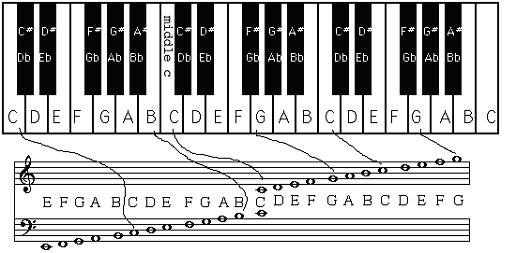
Black notes are placed in a particular fashion in between White notes…in the piano/keyboard !


They are denoted as,

either Sharp (#) of previous white note
or Flat (b) of succeeding white note

For example, You can call the black note next to C as either C-Sharp or D-Flat…. and so on...!

Then the question arise…in G-Major scale, whether the black note shall be called F-Sharp or G-flat…

The answer lies in the simple rule that is :

to form a Scale using the seven notes (alphabets)..

“Use each letter certainly once…but ONLY once…”
That simply answers why it is called F-Sharp in G-Major..

If we use G-Flat, we use the letter G twice…….which is not correct……. and also we are not using the letter F at all.. again not correct……

Also observe that the interval title will change if we use the different letter names…!

For example : E to F-sharp…. we will call it…Major 2nd…….

But in case of using flat, E to G-flat will have to be called a kind of 3rd……. Diminished 3rd….precisely…..!

Even though we are talking about the same two keys in a piano/ keyboard, even though the sound quality of the interval is same…the name changes…!

Symbols like Sharp and Flat (and one more symbol called Natural….meaning returning to normal by canceling the sharp or flat effect…. We will see later…..) are called Accidentals

So using the right kind of accidentals is a must while notifying the black notes…!

Returning to our G-Major scale analysis……
Nothing new to add about this G_Major…since we know a lot about the C-Major… the basics are same…

Now G has become Tonic, A is Supertonic, B is the Mediant and so on….!

All the interval pattern remains the same… only the letters change…!

Whether it is Tonic to others…or… any note to any note…we can manage naming intervals…! Can we ….?

SO whether it is C to G in case of C-major or G to D in case of G-Major, the interval is same…Perfect 5th….! And so on…!

But one thing I want you to observe…..!

I deliberately made you to climb 8th floor…ie … from C to G......in terms of musical interval, We reached a Perfect 5th above the Tonic of C major…. To reach the G-Major…

and we found the note F is sharped..to preserve the Major scale…and one black note is added…! ……

Which is….one letter before the tonic we selected to analyse…! F-Sharp…!

If we generalise this as a finding…. And try to analyse the next Major by selecting the note a Perfect 5th above the current G-Major…..which is nothing but D…..!

Can we say blindly…the D-Major will have 2 black notes…?

In addition to already selected black note of F-sharp….This time the note before D….. which is “C” will also be sharped to preserve the Major Scale pattern…?

Try it… you can’t believe it….our hypothesis is right….absolutely right…..!

Looks like some algebra….series….!

So D-Major is D-E-F#-G-A-B-C#-D
If you grasp this simple principle…. You can follow any Major scale…. starting from C onwards…..!

Major scales in steps of Perfect 5th starting from C-Major are :

C-Major, G-Major, D-Major, A-Major and E-Major.

Till such time you exhaust all the 5 black notes and you will ask me what to do next…..?

Simple….! Add one more sharp…. And make it Double sharp….. meaning you climbed two consecutive notes above….!

So after E-Major, the Perfect 5th above scales are:

B-Major, F#-Major, C#-Major...... etc etc.

That ends one cycle from C to C# Major.

So try yourself the major scales on all 12 notes starting from C onwards….using the sharp technique…..!

Each time note down the notes sharped so far….! And try to tabulate the exercise as a summary.

That’s very big climb for us in terms of our lessons….!

Completely knowing all Major scales of sharp…!

You are not only wiser now, you are Sharper also……!

Thursday, April 6, 2006

Lesson-25 : The Major Scales with Sharps - Analysis : Part-3

Hi All,

Maths helps us a lot in analysing and understanding the Music..!

Do you realise that….?

As explained earlier, the addition of black notes ( Sharps) occur in a pattern..! It's a beautiul pattern !

Our series of Major Scale starting from C .. every time jump to the perfect 5th (meaning the 5th or Dominant of the previous Major scale) and make that note as the Tonic or first note of the new Major scale.

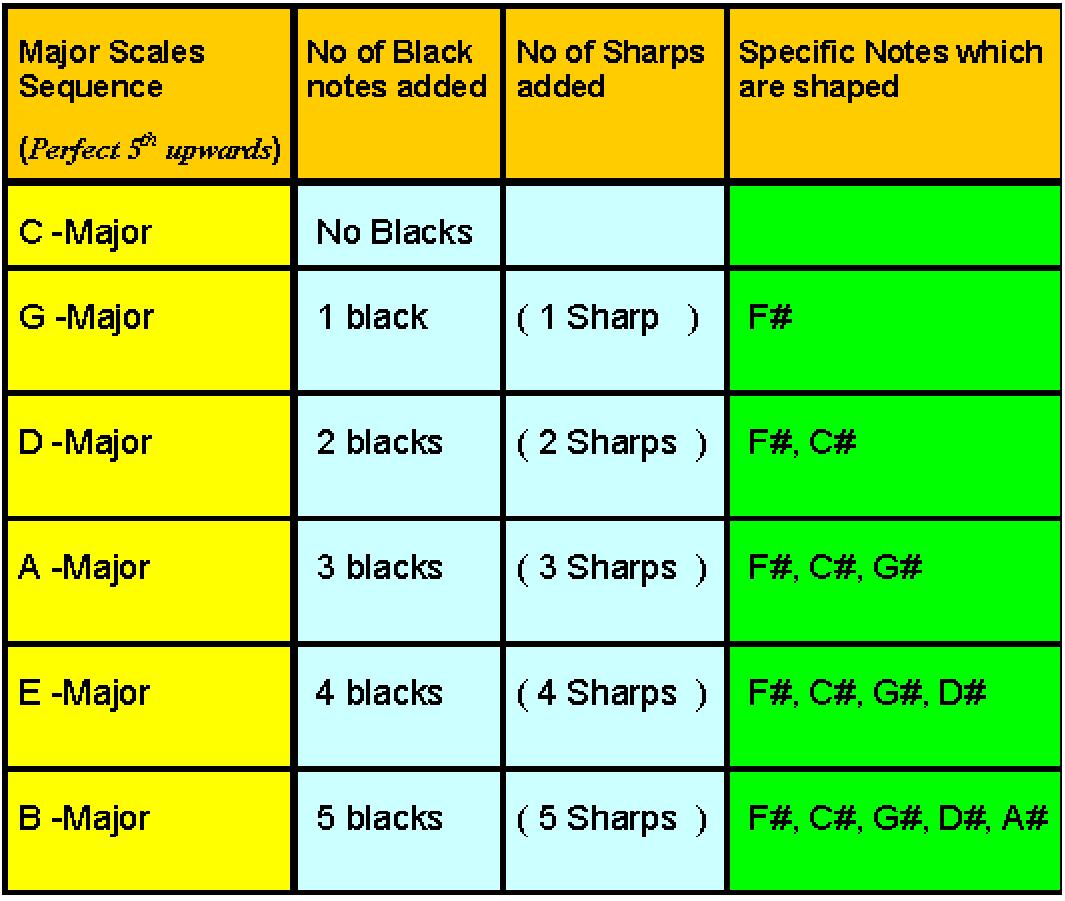
Let me summarise the series of Major Scales…


Now, continuing the abvoe series, the perfect 5th of B-Major is F# and hence next scale has to be F# Major and the note that need to be sharpened is E … ie… E#....

Note carefully, E# is not a black note
for all practical purpose that is a white note F….!

But the naming convention makes us to say that as E#...thats all !

Same way, next Major Scale after F#-Major is C# Major and this one will sharp the fifth note B ie B#..which is again not a black note and only the white note…C…

So we have completed one cycle of 7 notes sharpened.

Let me add the above two Major scales in the list…!


Theoretically, let us try one more Major in that sequence… which has to be G# Major…

Now we will land up in F-Double Sharp (F##)..!

If you sharp F two times, you land up in G (which is semi tone below the G# and thus ok.)…!

So the notes are same,,, but expressing is different…

May be slightly (???) confusing in the beginning…but mathematically easy to recognize…!

So you can add the remaining double sharp major scales also… but for the time being we will leave it, as these have not much significance…!

What is important is that we have understood that :

Major Scales starting on different keys can be easily formed based on the simple observations of sequence of notes getting sharpened when proceeded in Perfect 5th….!

That’s all. !

It is important to remember the sequence of Major scales that are coming one after another ….

And at the same time… more important is to remember the notes sharpened in each Major scales..each time..!

The notes getting sharpened in sequence are :

F, C, G, D, A, E, B

(after that …? Easy…..double sharp the letters in the same sequence…)

To remember this, the following sentence may be noted:

Father - Charles - Goes - Down - And - Ends – Battle
Remember this,, you will easily get sequence of sharp notes…of course the corresponding major scale is one letter next to the last sharp…!

Enough for today to assimilate…!

If you want a little bit go further…. You can attempt the following exercises :

1. Using Crotchets, try to write each of the Major scales in a stave ..one octave ascending and then descending… Write the sharp in front of the notes as applicable.

2. Try to play these Major scales one by one on the key board slowly….


3. Try to write yourself any two notes one above another…and check yourself the interval….and name the note as Dominant, Tonic, Mediant etc etc…


4. Whether these two notes are coming in any Major scale ? some time forming part of more than one major scales also ?


5. If more than one major scale, note and name the notes according to that Scale…!
More you go deep, more you understand…the inter relationships….!

Don’t get tensed about the complexity….If you have understood the basics concepts…. You are 90% through…!

All the other things will come …by practice…just sheer practice…..!

As IR says in one of his interview…. "Music Music nu… paithiyamagave aaganum(You should become mad after music….to achieve this..)

IF we have luck and divine intervention…. And of course…if we have the TIME…. We can attempt that…!

Wednesday, April 5, 2006

Lesson-26 : The Flattened Major Scales : Part-1

Hi All,

Let us continue our analysis of ....what else…same Major Scales…!

Just earlier we saw the Major scales with sharps ..in increasing order...!

This time we will study about the Major scales with Flats !

Though all of you are familiar, let me repeat the pattern of Major Scale which is

(Whole + Whole + Semi ) + Whole + (Whole + Whole + Semi)
The pure white keys make the C-Major : C – D – E – F – G – A – B – C

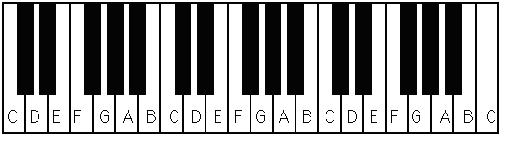
Jusr refer the following figure of keyboard also for easy reference!


While enlisting Sharps usage in Major…..we went for Perfect 5th upward every time from the previous one…..!

This time can you guess…what…we are going to do....?

Just travel Perfect 5th downward each time….! That’s all….!
Starting from C….! travel perfect 5th in reverse direction.....You will land up in F…. !

[Alternatively… A perfect 5th downward means… Perfect 4th upwards…which is easy for you…! ..

but sharp means going upward… and flat means going downward….

So this convention…

Also we are traveling symmetrically on either side left (upward) and right (downward) of C…Major........by a Perfect 5th distance…..! ]
So our first flat major is F-Major…..

Follow the standard pattern of major scale… and you will get these

F – G – A – ………

Now if you select B for the next letter, you will land up in whole tone against the requirement of Semitone… So what…?

Come to the black note before B and express it as B-Flat…..

and then proceed with C – D – E – F …..

Yes….the last Semi between E & F automatically got matched…!

So the major scale on F is constructed as follows :

F – G – A – B-Flat – C – D – E – F

So the new black key is the 4th note ie the Sub-Dominant ….

Hope you don’t get baffled by the jargons, finding etc….now….! Are you ??

So for the next 2-flats major, we should travel a Perfect 5th downward from the present F-Major … (or travel Perfect 4th upwards…)….

Which is nothing but the B-Flat ….the note just now blackened…sorry… flattened….!

So this is another finding…that….

Every time the next Major scale in the flat-major scales series is nothing but the latest additional note Flattened in the previous scale…..! (and located as 4th note of previous Major….) …
( Let me use the small letter (b) for the flat to take care of HTML constraints of the posting )

So B(b) – Major is as follows :

B(b) – C – D – E(b) – F – G – A – B(b)

So next major scale is naturally the 4th note E(b) – Major which is as follows :

E(b) – F – G – A(b)B(b) – C – D – E(b)
If we proceed on these series in this manner… …..

we will first exhaust all 5 black keys …….and then …..

add the two white keys as B & E representing them as C-Flat and F-Flat……

then onwards….add double flats to represent remaining white keys….!

Everything is same as the case of Sharp Majors…..!

So easy to learn mathematically ! Of course a lot of efforts and practice required for practical usage !

Tuesday, April 4, 2006

Lesson-27 : The Flattened Major Scales : Part-2

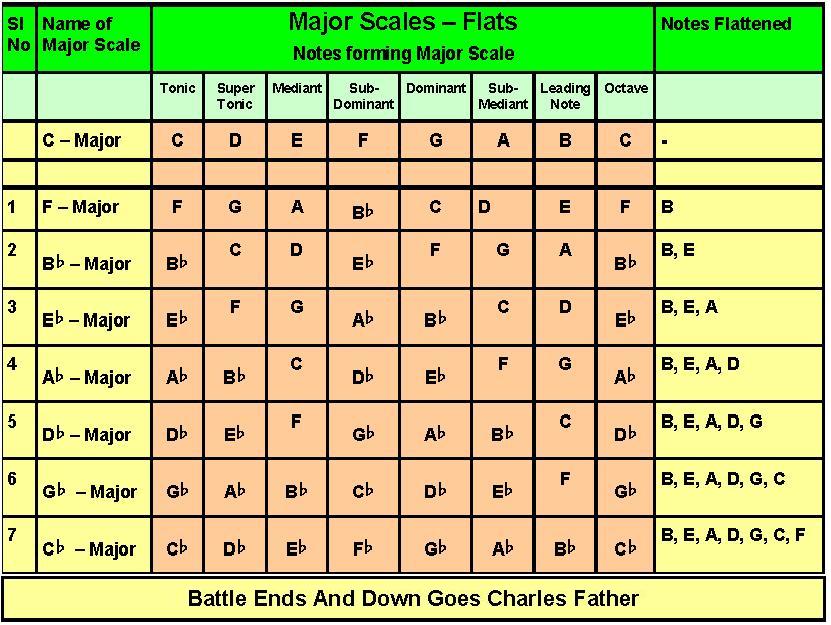
Let us summarise all the Major scales of Flats and the notes progressively flattened each time to get the overall idea….!


So theoretically, the next major scale F(b)- Major will have B-Double flats and so on…..

Omitting other double flat majors…

From C-Major to C-Flat Major, Let us carefully watch the Sequence of notes flattened each time… and list it….! (refer to the last column of above table)

They are….. B, E, A, D, G, C, F…..!

Oh God…. What a striking mathe-magic we are getting here…..!

When compared to Sharps sequence…this Flat sequence is…Exactly the Reverse of Sharp sequence….!

Is it not amazing……!

Incidentally the sentence given for Sharps can also be reversed and still makes sense…!

Battle Ends And Down Goes Charles Father !

Remember this sentence for Flat Majors….!

So…You are having knowledge of 15 Majors now in terms of Sharp & Flats....

And you agree that theory of music is easy to figure out with little bit of maths and logic…!

But, the practical portion is not…!

You have to do a lot of hard work to remember and play them in an instrument…!

A lot …lot ….lot….. practice….!

For theorists… just a careful remembrance of these observations and logics will do…!

If we cannot play we can make the others play and listen and observe…!

Now-a-days…”others’” list ….has added the Computer also…!

So we can still travel a lot into the WCM theory zone…!

But take a while, to consolidate all the Major scales, in terms of Sharps, Flats…..Their relative naming each time….!

The various intervals formation.. etc…etc….!

The visualization of these major scale on a instrument arrangement…their sound quality and feeling….!

FEEEEEEEEEEEEEEEEEEEEEEL That….!

Monday, April 3, 2006

Lesson-28 : Key Signatures - Key to Simplification!

Hi All,

Some of you (!?) might have tried to write the Major scales explained so far in the form of notes on a Stave..!

Ok…… even if you haven’t tried so far, imagine you are going to do that .. or somebody wants to write notes for a song in one of these major scales….!

Other than C-Major, in all other major scales you are either having sharps or flats..!

The way of writing these “accidentals” is to put down the concerned symbols before each of the note..!

In case of G-Major, wherever F is coming, you are bound to put the sharp before that…!

Imagine the case of B- Major or D-flat Major….the number of notes sharpened or flattened are too many……which complicates writing of notes as well as reading them…!

You realize that…? How to tackle that….?

The answer given by WCM convention is to use “Key Signature”


  • Write down the sharps or flats which are going to be used in the particular Major Scale…
  • in the beginning itself,
  • after the Clef symbol (treble or bass ),
  • in the appropriate space or lines as the case may be….….
  • ONLY ONCE….
  • then you need not bother to write it each time before each note… !
For example, in the case of G-Major, you write the sharp symbol in the 5th line of Treble Clef (Every Green Bus Drives Fast….) and 4th line in case of Bass Clef (Good Boys Deserve Fine Apple) to notify that “ hereafter Any note written for F shall be read as F-Sharp”…….!

In case of E-flat Major, we know that the notes B,E, A are flattened….So write the flat symbols in the concerned space or lines of treble or bass clef for the letters B, E and A once in the beginning and notify that…

hereafter Any note written for B, E and A shall be read as B-Flat, E-Flat and A-Flat respectively….!
Such Cluster of symbols of flats or sharps written in the beginning (after Clef symbol) is called the “Key Signatures”
Conversely, Just by seeing the key signature location and noting the number of flats or sharps, one can easily say What the Scale of the song is….!
So players of instruments or singers, just see the key signature at start and guess the type of Major Scale.. and everything else automatically falls in line…!
For the novice, it will be a problem and may make some mistakes of omitting the sharps or flats…but those who have perfected the Major Scales, its part of routine…!

Thus the complication of writing as well as reading of notes simplified by using “Key Signature”

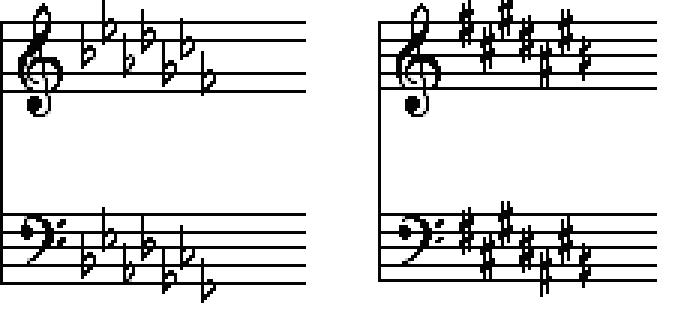
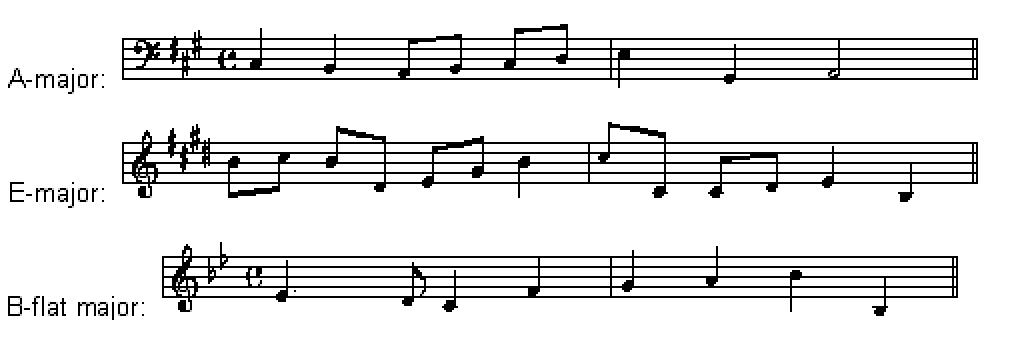
Some examples of major scale passages with key signature are given below:


There are some conventions while using the key signatures :

The order of writing the sharps or flats is the same as the sequence of the notes getting sharpened or flattened in each of the Major Scales….

We know the sentences
- Father Charles Goes Down And Ends Battle
- Battle Ends And Down Goes Father Charles


Key Signatures are written at the beginning of each line

Even though same letter may be coming in space or line also, the place of sharps or flats in a stave is pre-determined and only that should be used.. !

By chance, if any other notes, other than the normal notes, to be sharpened or flattened, these shall be written in front of the concerned notes (in the song) only and NOT in the key signatures !

(these are rare cases…. when modulation or something occurs…then some additional notes are sharpened or flattened …)

So, we have understood the term and purpose and usage of Key signatures.
Such key signatures are used in the case of Minor Scales also, which we are going to know about soon.

Sunday, April 2, 2006

Lesson-29: Why So Many Majors ?

So far we have seen all the Major scales possible with Sharps and Flats.

C-Major and 7 other majors with sharps and 7 other Majors with Flats. Total 15 Major scales, have been summarised below:


As we know, there are 7 white notes and 5 black notes in an octave, out of these 15 Majors, some 3 Major scales are repetitive also.

I could certainly feel a query that is in the back of all of your mind all these time…., and wanted to pose it to me anytime now…! …

The question may be something like this …:

“You told about the Major scale that started in C and conveniently I can get it with all adjacent white notes…!

Then why at all you bother me with G-Major, D-Major etc etc.. and getting into those black notes ….trouble to learn both theoretically as well as practically…

If I could play a song in major scale in C-Major, why at all I shall bother to play the same song in some other Major scale….

after all everything is Major scale … and the same… same….. saaaaaame……… major scale…."
Well, frankly speaking I was also puzzled, during my learning time with the same query.

And to some extent, still remain puzzled with the limitations WCM exponents have posed for themselves with One Major scale ( represented in different starting keys…)

[and One Harmonic Minor scale and One Melodic Minor scale (again represented in different starting keys each time)…! (Minor scales… we will learn soon…)]

Certain guessing answers I can make… in order to clarify the above query…May be right .. May not be right also…! But let me try...!

We have seen that the range of voice of each human being is different…!

So different starting point to suit the each individual is necessary…!

All music rules normally take care of such human factor utmost…!

That way different starting point for the same Scale might have been envisaged…! That forms one answer !

Another answer is the concept of Modulation !

WCM strongly advises to change the induced monotony in a song in the same scale, by shifting to other scale which is very nearby….

Meaning try to change only one note at a time and shift to another scale..!

Such process of changing is called Modulation…!

(A technique strongly supported by WCM…but strongly opposed by Carnatic scheme ! )
For example….if you are playing C major for quite some time… show some change by shifting to nearby G-Major…which is just effected by change of F to F# as far as key is concerned…

But now you shall categorically know… that by doing so, we have shifted the Tonic from C to G…..

and thus old Tonic (C) has become the new Sub-Dominant……
old Supertonic (D) has become the new Dominant etc….etc. etc…

Even though you are still playing some form of Major scale only, still you can feel some difference due to the Tonic shift…

One good example of "simple" modulation in old song of MSV which is a Minor scale song..…is Raajavin Paarvai Raaniyin pakkam…!

There will be some shifting of tonic effected by a Chorus and instruments in one of the interludes….!

Another "simple" example is ARR's "Oooh Lalal Laa!" of Minsaarak Kanavu. At the end of song, we can hear this modulation with chorus voices!

So you can travel from C-Major to G-Major with ease and come back to C-Major again with ease….Do you agree that…?

Instead of coming back…… if you want to go further upward side from GMajor….. where you can go…?

You can easily guess that D-major is the next easier to reach with ONE note modification of C to C# now….!

Again tonic shift etc etc happens…. but that's smooth transition…!

Similarly,one can chaneg from Major scale to Minor Scale and back !

IR always uses such complex type of modulations in almost all of his songs! That will be mind blowing to watch and listen!

So WCM breaks the monotony in their own way….! The pattern of Major or Minor scale is still same! But some tonal color changes…makes it afresh…!

We will see in detail about Modulation later….!

What I just wanted to show you…is...that …some approach of WCM needs these different type of Major Scales….!

Soon We will start with Minor Scales !

Saturday, April 1, 2006

Lesson-30 : Summary of Major Understandings!

Before proceeding further to"Minor Scales",

Its time for summarizing the understandings of various findings on Major scales of Sharps & Flats as well as other learnings on the accidentals, modulation etc.

US-1 : In a keyboard,or piano, Black notes are placed in a particular fashion in between White notes. They are called either Sharp (#) of previous white note or Flat (b) of succeeding note…

US-2 : Symbols like Sharp and Flat (and one more symbol called Natural….meaning returning to normalcy by canceling the sharp or flat effect..) are called Accidentals

US-3 : The simple rule to form a Scale using the seven notes (alphabets).. “Use each letter certainly once…but ONLY once…”

US-4 : Major Scales of Sharps can be formed by proceeding Perfect 5th upward each time from the tonic of previous scale.

Each time the leading note gets sharpened in addition to the previous sharps.

US-5 : The sequence of notes getting sharpened each time is F, C, G, D, A, E, B respectively for the Major scales of G, D, A, E, B, F#, C# .

Remember the sentence for Sharp Majors:
Father - Charles - Goes - Down - And - Ends – Battle

US-6 : Similarly Major Scales of Flats can be formed by proceeding Perfect 5th downward (or Perfect 4th upward..) each time from the tonic of previous scale.

Each time the Sub-dominant is getting flattened in addition to the previous flats.

US-7 : The sequence of notes getting flattened each time is B, E, A, D, G, C, F respectively for the Major Scales of F, B-flat, E-Flat, A-flat, D-Flat, G-Flat, C-Flat and F-Flat.

This is exactly the reverse of the sharp sequence.
Remember the sentence for Flat Majors:
Battle Ends And Down Goes Charles Father !
US-8 :WCM strongly advises to change the induced monotony in a song in the same scale, by shifting to other scale which is very nearby…. Meaning try to change only one note at a time and shift to another scale..!

Such process of changing is called Modulation…!

(A technique strongly supported by WCM…but strongly opposed by Carnatic scheme ! )